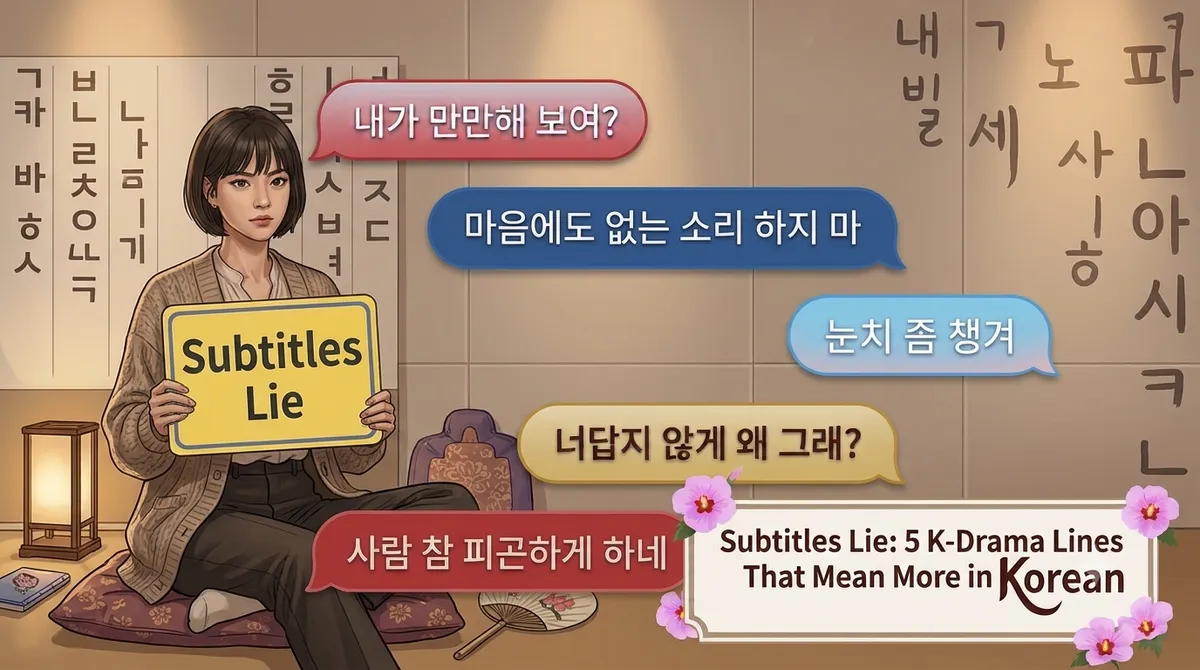
Learning Korean ruined subtitles for me, in the best way. I study Korean in India, and once you start catching what characters actually say, you can’t unsee the gap between the words on the screen and the feeling behind them. English subtitles give us the general meaning of a sentence but often miss the attitude: a sarcastic remark becomes an ordinary question, a warning sounds like a simple complaint, and a phrase that seems harmless in English can be surprisingly sharp in Korean. None of these expressions are difficult vocabulary. They’re phrases native speakers use every day when they’re frustrated, challenging someone or reacting to an awkward moment, so if you’ve watched a K-drama with subtitles, you’ve almost certainly met all five of these. Here’s what the characters are really saying.
1. “Do I look easy to you?” (내가 만만해 보여? Naega manmanhae boyeo?)
The subtitle usually reads “Do I look easy to you?”, but what the character means is closer to “Do you think I’m a pushover?” You’ll hear it in confrontations, usually when someone feels they’re being taken advantage of. The key word is 만만하다 (manmanhada), which describes someone or something that seems easy to deal with, handle or overcome, so the character isn’t asking whether they look physically approachable. They’re challenging the other person’s attitude. Imagine someone who repeatedly ignores your boundaries, assumes you’ll always forgive them or treats your kindness as weakness, until you finally say, "내가 그렇게 만만해 보여?" The emotional message is much closer to “Do you seriously think you can treat me like this?”, and it carries wounded pride and defiance without needing a long explanation. Next time you hear it, notice whether the character is angry about one specific action or about being underestimated altogether.
2. “Don’t say that.” (마음에도 없는 소리 하지 마 Maeumedo eomneun sori haji ma)
The subtitle says “Don’t say that,” but the Korean is far more revealing: “Don’t say something you don’t mean.” The phrase 마음에도 없는 말 or 소리 refers to words that don’t genuinely reflect what someone feels or thinks, so 마음에도 없는 소리 하지 마 tells someone not to say something that isn’t coming from their heart. Picture a character shouting “I never want to see you again” in the middle of an argument, and the other person quietly answering, "마음에도 없는 소리 하지 마." They aren’t telling them to stop talking. They’re suggesting that the words don’t match what the person actually feels. The same line works on insincere compliments, empty promises and things said only to please someone, because the point is always the difference between saying something and meaning it. It often reveals a character who understands another person’s emotions better than that person is willing to admit.
3. “Read the room.” (눈치 좀 챙겨 Nunchi jom chaenggyeo)
The English subtitle sounds like friendly advice, but the Korean carries a sharper criticism: “Pay attention. Can’t you tell what’s going on?” 눈치 (nunchi) is a particularly interesting Korean concept. It’s the ability to understand situations, notice social cues and pick up on what others are thinking or feeling without being told directly, while 챙기다 (chaenggida) generally means to take care of, look after or make sure something is attended to. Together, 눈치 좀 챙겨 is an informal and often blunt way of telling someone to become more aware of their surroundings. Imagine a group of friends discussing something serious, everyone visibly uncomfortable, while one person keeps making jokes until someone turns around and says, "눈치 좀 챙겨!" It isn’t only about understanding the atmosphere. It’s about failing to notice something everyone else already understands, and it often appears in romantic scenes when someone misses another person’s obvious hints. Nunchi isn’t simply being observant. It’s understanding what a situation needs without anyone having to explain it.
4. “What’s wrong with you?” (너답지 않게 왜 그래? Neodapji anke wae geurae?)
This is one of those lines where the English translation can completely change the emotional impression of a scene. “What’s wrong with you?” sounds like an insult, but the Korean is closer to “Why are you acting so unlike yourself?” The phrase 너답지 않게 comes from 너답다 (neodapda), meaning to be like yourself or to behave in a way that reflects your usual personality, so the speaker is pointing out that the other person’s behaviour is unusual for them. Picture a usually confident friend who suddenly avoids everyone, makes excuses or gives up on something they once cared about, and someone close asks, "너답지 않게 왜 그래?" It can communicate genuine concern, as in “This isn’t like you. What’s happening?”, though depending on the situation it can also sound critical or disappointed, as if the person is falling below their usual standard. Either way, it comes from someone who knows the other person well, which is exactly why the change stands out.
5. “You’re exhausting.” (사람 참 피곤하게 하네 Saram cham pigonhage hane)
The subtitle reads “You’re exhausting,” but a more natural meaning is “You really wear me out.” 피곤하다 (pigonhada) means to be tired, but when it describes someone’s behaviour, it suggests that dealing with them is mentally or emotionally draining. Imagine a character who keeps changing plans, creating unnecessary arguments or refusing to understand something simple, until the other person sighs and says, "사람 참 피곤하게 하네." The literal structure is closer to “You really make a person tired,” and the speaker isn’t necessarily physically tired at all. They’re expressing frustration with the effort of dealing with someone. Depending on the delivery, it can sound genuinely annoyed, teasing or playfully exasperated between people who know each other well, and it shows how Korean speakers use physical tiredness to describe emotional exhaustion.
The challenge with all five isn’t vocabulary, it’s intention. “Do I look easy to you?” and “Don’t say something you don’t mean” are both emotional, but they communicate very different things, and Korean relies heavily on context, so the same expression can sound playful between close friends and disrespectful between strangers. K-drama characters also rarely say their feelings directly. They use sarcasm, rhetorical questions and ordinary-sounding remarks to express something much stronger, and subtitles, which have to be quick, can’t always carry every layer. Indian viewers will recognise this problem, because a dramatic Hindi dialogue loses its sting in English subtitles too.
Final Thoughts
Subtitles do an impressive job under pressure, but they’re built for speed, and speed leaves little room for tone, for the history between two people, or for the feeling packed into a four-word sentence. That’s why a line like 눈치 좀 챙겨 can arrive on screen as a polite “Read the room” while landing with real sharpness in Korean. None of this makes subtitles bad. It just means they show you the plot, while the original language shows you the people.
So the next time you watch a K-drama, don’t just read the screen. Listen to how characters phrase their responses, and notice when someone challenges another person instead of shouting, or drops a small remark that reveals familiarity or disappointment. You might discover that a character wasn’t simply saying “What’s wrong with you?” They were saying, “You’re not acting like yourself, and I noticed.” Subtitles can translate the words, but understanding the intention takes a little more than reading.